
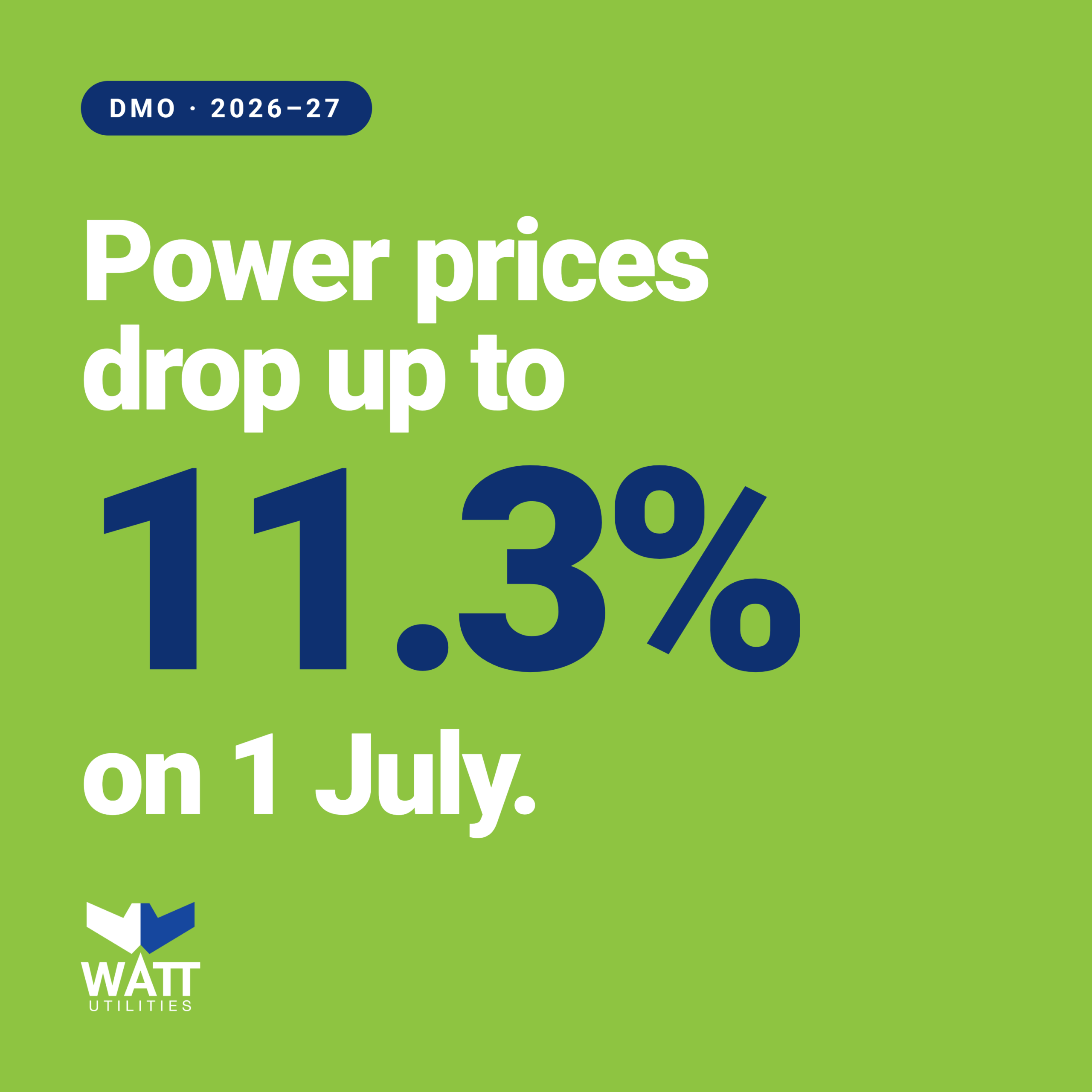
From 1 July 2026, the default electricity price benchmark for small businesses and households across New South Wales, South East Queensland and South Australia is changing. After two years of sharp increases that caused a lot of bill shock, the news this time around is more positive: prices are coming down across most regions.
With less than a month until the changes take effect, now is a good time to understand what’s coming and whether your business is set up to take advantage of the lower pricing environment. This article explains what’s happening, what the numbers mean, and what to think about before 1 July arrives.
The Default Market Offer, or DMO, is a regulated price ceiling set each year by the Australian Energy Regulator (AER), the government body responsible for overseeing energy markets in Australia. The DMO applies in New South Wales, South East Queensland and South Australia, and it caps what electricity retailers can charge customers who are on a standard or “standing offer” plan.
A standing offer is the default plan a business ends up on when it hasn’t actively chosen a specific energy deal. It’s the equivalent of not shopping around and just paying whatever the retailer’s standard rate is. The DMO caps how high that rate can go, so customers on standing offers have some protection against being overcharged.
For businesses already on a negotiated market offer through a broker or directly with a retailer, the DMO doesn’t directly change their bill. It does act as a useful benchmark, though. When our team compares market offers on a client’s behalf, the DMO is one of the reference points we use to gauge how competitive a deal actually is.
The AER released its final determination for the 2026-27 DMO on 2 June 2026. Prices are falling across most regions, with small businesses seeing larger reductions than residential customers.
| Region | 2025-26 DMO | 2026-27 DMO | Change |
|---|---|---|---|
| Ausgrid (NSW) | $4,977 | $4,523 | -9.1% |
| Endeavour Energy (NSW) | $4,775 | $4,343 | -9.0% |
| Essential Energy (NSW) | $6,222 | $5,517 | -11.3% |
| Energex (QLD) | $4,294 | $3,849 | -10.4% |
| SA Power Networks (SA) | $5,541 | $5,162 | -6.8% |
Source: Australian Energy Regulator, Default Market Offer 2026-27 Final Determination (2 June 2026). Annual bill estimates based on assumed usage of 10,000 kWh (kilowatt-hours) per year on flat rate tariffs.
South Australia is worth noting separately. Small business prices there are still falling, so that’s good news. For residential customers in SA, the picture is different: they are the one exception to the broader trend, with standing offer prices rising slightly from the previous year. This came down to higher wholesale electricity costs in SA during 2025, driven by specific supply events that didn’t affect other states to the same degree.
The DMO is built from several cost components that the regulator adds together to form the benchmark price. This year, most of those components moved in the same direction.
Wholesale electricity costs fell across all regions, supported by lower contract prices and increased output from wind and battery generation. Environmental costs, which cover things like the government’s renewable energy programs, also declined. Retail operating costs came down as well.
Network costs, the charges for using the poles, wires and meters that deliver electricity to your premises, went up in some regions. Those increases were outweighed by the reductions in other cost components, resulting in lower overall prices across most of the country. Network charges make up a substantial portion of any electricity bill, so it’s worth knowing they’re not uniformly heading down.
This depends on what kind of plan your business is currently on, and it’s the right question to ask.
If your business is still on a standing offer, the lower DMO means the capped rate has dropped, so you may see some relief on your bills. Standing offers are rarely the most competitive option available, so if you’re on one, it’s worth treating this as a prompt to review your situation properly.
If you’re already on a market offer, the DMO shift doesn’t automatically change your rate. Your contract pricing was locked in when you signed. The shift does signal that market conditions have softened, which means there’s a good chance more competitive deals are available now than there were 12 to 24 months ago. Our energy cost reduction service is built around finding exactly those opportunities.
Tariff structure also plays a role. Many businesses are on flat-rate tariffs, meaning they pay the same rate per kilowatt-hour (a standard unit of electricity, roughly what a microwave uses in an hour) regardless of when they use power. Time-of-use tariffs, which charge different rates depending on the time of day, are becoming more common as smart meter rollouts continue across Australia. Whether you benefit from a lower DMO can depend on how your tariff is structured and when your business draws the most power.
For strata managers and businesses running multiple sites, each meter is potentially on a different plan, a different tariff and a different contract expiry date. A shift in the DMO benchmark is a useful prompt to review each account rather than assuming savings are flowing through automatically.
The end of the financial year is a common contract renewal point, and leaving it too late means some accounts may roll over onto default rates before a better deal is locked in. Our services cover portfolio-level reviews, so nothing gets overlooked.
A changing price environment is a good reason to review your energy contracts, particularly if any are coming up for renewal or haven’t been looked at in the past year or two. The market has shifted, and plans that were competitive in 2024 may no longer be the best available.
Our energy managers at Watt Utilities handle this review process for businesses and strata clients. We compare your current rates against available market offers, check how your tariff structure aligns with how each property actually uses energy, and present clear options without the jargon. If there’s a better deal, we’ll find it and manage the transition.
Our energy managers review your current contracts, compare available market offers and handle the switch if there’s a better deal. No cost, no obligation.
Get Expert AdviceDisclaimer
This article provides general guidance based on the Australian Energy Regulator’s Default Market Offer 2026-27 Final Determination (2 June 2026). DMO prices represent benchmark annual bills based on assumed usage of 10,000 kWh per year for small businesses on flat rate tariffs. Actual bills will vary depending on usage, tariff structure, location and contract terms. The DMO applies to New South Wales, South East Queensland and South Australia only. For energy procurement advice tailored to your business, contact our team.



Fields marked with * are required.